Showing posts with label The Heritage. Show all posts

Monday, May 11, 2009

History Of Architectural Lighting Part 2

HISTORY OF ARCHITECTURAL LIGHTING II

ARTIFICIAL LIGHT
Flame was used in ancient history in mankind, first was burning branches was used then special wood to get long lasting light and artificially aesthetic and lead to the use of flammable material. And the development of flame had changed the artificial light widely. The invention of oil lamp and candle, made man realized how small and compact source of light could be.

The oil lamp represented the highest form of lighting engineering progress for a very long time. Then the lamp were developed into sorts of magnificent chandeliers and sconces and available in a wide variety of styles but the flame, and its luminous power remained unchanged.
The development of oil lamp lead to some inventions such as the lenses, argand lamps and finally the invention of new light sources


MODERN LIGHT
The invention of gas lighting was the basic of modern light source. Gas lighting was demonstrated in a series of pilot projects such as a lecture hall in Löwen lit by Jan Pieter Minckellaer and a factory, a private home and even an automobile lit by the English engineer William Murdoch. This new light source achieved as yet unknown illuminance levels due to the high cost and manufacture problems.

Then incandescent gas light was doomed to go the way of most lighting discoveries that were fated to be overtaken by new light. The needs to have more efficient lighting source led to scientific research of the electric lamp in 19th century, it showed up and embarked on its career in its brightest form. The beginning of modern light sources. The Moore Lamps was used for advertising purposes and in architectural spaces as contour lighting. And mercury lamp was also used due to its good luminous efficacy.

After hundreds of years, artificial lighting changed dramatically and basic lamps were developed to the standard lamps as we use today. The artificial lighting is used in interior and exterior space for artistic and safety purposes. New studies in lighting specialist emerged to provide standard form of lighting, psychological effects of lighting and for guideline lighting in general.

Read More......

Friday, April 24, 2009

History Of Architectural Lighting Part 1

HISTORY OF ARCHITECTURAL LIGHTING I
I am in the mood of writing history in architecture and interior design lately, and now I am going to reveal a brief history of architectural lighting. :)
There were 2 sources of light for centuries ago, daylight as natural light and flame as artificial light.

NATURAL LIGHT
Daylight of course had impact in architecture lighting design in the past centuries, The building must adapt to requirement for natural lighting, for example the size of the rooms were designed by the availability of natural light as well as ventilation. This condition were developed in architecture design around the world in different climatic zone. We can see it from old and historical buildings around us.

In the cooler climate, the architecture building were built with tall and large windows to allow the light into the building, as much as possible.
Different thing in sunny and dry climate, where the sun shine everyday. Dominantly buildings with small window with reflective exterior walls.


To play with aesthetic quality in architectural lighting with natural daylight, we can see from the architectural details in the building, Certain elements were designed according to the natural light available to get the spacial effect through the light and shadow. The elements were columns, reliefs, ledges, diffusers on windows, and facades. The perfect example are old churches from baroque period or ancient Egyptian pyramid. Those building were built with special lighting effects to adapt the natural light.
Because architectural construction, especially in old period have similar function with astronomical clock, with detailed design and high accuracy to create special lighting effects only occurring on significant days or during particular periods in the year, when the sun rises or sets, or at the summer or the winter solstice.

Read More......

Monday, April 06, 2009

History Of Apartment Building Design Part II


History Of Apartment Building Design Part II
In previous article, I wrote about luxurious apartment design and now about low income apartment design to accomodate lower class residents which was dominant in early 20th century.

LOW INCOME BUILDING DESIGN
For low- and middle-income tenants, apartment building design was a combination between aesthetic and economic viability, even sometime abandoned the sanitary concern and aesthetic to get more profit. Apartment building was great issue in social and housing reform.

This was a challenge for architects, they used this apartment buiding design to explore new materials, prefabricated structural system to provide affordable worker housing. The government also took part by sponsoring the housing projects. Examples can be seen from:
1. The housing policy of the Weimar Republic generated pioneering modern apartment buildings for German cities
2. J.J.P.Oud’s Kiefhoek housing (1925), an International Style garden apartment complex built in
Rotterdam. Both the garden apartment and the high-rise form of the apartment building
were explored by architects throughout the mid-20th century.
3. A key high-rise example in London is Highpoint I (1933–35), designed by Berthold Lubetkin and Tecton.

These two primary apartment building design forms—the mainly urban high-rise and the suburban garden apartment—became internationally prevalent by the 1930s. They distributed the rising cost of elevators, ventilation, and other systems-related apparatus by using modern building materials to create taller structures with more living units. Garden apartments were suitable for lower-density development on the urban periphery, where land was less expensive.


POST WAR PERIOD
In post WW II period, the housing crisis became the great issue and the European government again sponsored the construction of housing projects, to move the economy as well. And then followed by Us government. During this period, the dominant style was the international style modernism particularly slab-form high-rise developed by Le Corbusier.
as we can see from Le Corbusier’s Unité d’Habitation (1947–53) at Marseilles, France. Unite d’Habitation is a 12-story horizontal slab raised on heavy tapered.

Noteworthy examples of apartment buildings done in a postwar modernist vocabulary include ATBAT housing (1951–56,Shadrach Woods and J.Bodiansky) in Morocco and Peabody Terraces (1964, José Luis
Sert) in Cambridge, Massachusetts.

During the postwar period, large-scale developments, including multiple high-rise apartment buildings, site planning, and amenities such as shopping and recreational facilities, became more prevalent.

By qsepti
source: 20th century architecture

Read More......

Wednesday, April 01, 2009

History Of Apartment Building Design Part I


History Of Apartment Building Design I
Apartment building is an integral part of human density in big cities. It changed the culture, habit in society. Due to the high growth of population especially in big cities in early 20th century, created the housing problem. The high density, shortage of land development and degradation of quality of life. The vertical building for housing was the answer to this matter. The verical building was considered as logical and effective solution.

An apartment building contains multiple dwelling units of one or more rooms. Including bathroom and kitchen for each unit, which are the basic aspects of the 20th century apartment building. And also heating, ventilation, air conditioning, and other system are provided as supporting service.

The efficient use of space is very important in apartment building design, just like any other commercial building design. And the efficiency must be balanced with comfort, this requirement is challenging especially when it comes to design apartment for low income tenants. Apartment building design in early 20th century usually provide public areas in minimal requirement such as small lobby, laundry room, roof deck, or swimming pool for more luxurious types.


LUXURIOUS BUILDING DESIGN
In the early 20th century, most of architecturally good design apartment buildings were dedicated for upper-class residents. Living in a full-service apartment building could provide a luxurious home at much smaller cost than maintaining a single-family house.

Rising land values in many cities made sole ownership prohibitively expensive even for the relatively well off. The buildings architecture moslty used the elements of Classical Revival and Italian Renaissance Revival as evidenced by the lavish examples built in cities such as New York, Chicago, Los Angeles, London, Paris, and Vienna. The dominance of historical styles in apartment building design in that period indicated the fashionable design mode for most commercial and domestic structures during the early 20 th century.

Read More......

Wednesday, March 18, 2009

Deconstructivism


DECONSTRUCTIVISM MOVEMENT
Decontructivism is a design style or movement that emerged in architecture, interior design, art, graphic design and philosophical literature in late 1980s early 1990s. Deconstructivism movement often refers to distorted, angular form, set in conflicting geometry and displaced.
Deconstructivsm generated iconoclastic architectural design as seen in some works, such as works of Zaha Hadid, Bernard Tschumi, Peter Eisenman, Morphosis, Rem Koolhaas, Daniel Libeskind, and Frank Gehry.


One of the example of deconstructivism movement is the work of Bernard Tschumi's design for the Parc de la Vilette in Paris. Tschumi proposed a nonhierarchical grid of dispersed pavilions instead of a more traditional building, echoing deconstruction’s own challenging of linguistic arrangements.

The beginning of deconstructive movement started in 1988 an event exhibition held by Museum of Modern Art in New York City with “Deconstructivist Architecture” and Tate Gallery in London with “Deconstruction in Art and Architecture”

Deconstruction emerged out of the post-structuralist tradition of literary theory, which in opposition to structuralism, stressed the slippage and fluctuation of meaning that is always at work in the process of linguistic and cultural signification.

by qsepti

Read More......

Friday, February 15, 2008

Blenduk Church


This church cannot be excluded from the history of Semarang old town. This Protestant Church Immanuel was used by two religions, catholic and Protestant before year 1870. Before Catholic Church St Joseph was built. In 1753 this church was built for the first time. The building adopted the Javanese roof style. Total renovation was done in 1787. The last design was developed by architect HPA de Wilde and W Westmaas during the renovation in 1894.


The music instrument

The pseudo Baroque style influenced this building. It is a common European architecture style in 17-19th century. The octagonal forms is used for main building with curved roof. The parabola roof design, which makes this church famous. It is called Blenduk in Javanese. The interior is quite unique. The altar also has octagonal form. An iron circular stair directs to an ancient music instrument inside the church, even though this instrument is no longer used. It was made by P Farwangler and Hummer.


the altar


interior view

Read More......

Thursday, January 10, 2008

Majolica House

Architect: Otto Wagner, 1898-1899. Located in Vienna, Austria.

This building type is mixed use, apartment housing. It’s six storeys building in art nouveau style. The unique part of this great building is the façade. It has textile print-like as decoration on its façade.


The textile print-like

Read More......

Tuesday, January 08, 2008

Interior of Tawang Railway Station

It is located in Semarang old town Indische Architecture is seen in this railway station building. Completed in 1870 by architect JP de Bordes. Back to old times, there was imaginary axis that connected this station to Protestant Church Blenduk.

The ceiling


window detail


interior of tawang


Tawang Railway Station

Read More......

Tuesday, January 01, 2008

Sam Poo Kong, A Chinese Temple

A Chinese temple lies in Simongan, Semarang. The history of this temple is connected to the voyage of Admiral Cheng Ho in 1430-1433 during Ming Dynasty. He was on the trade and peace mission. Admiral Cheng Ho is believed as Moslem; his stopped by in port Simongan and settled in a cave there. Nowadays, this temple becomes pilgrimage site not only for Kong Hu Cu or Chinese ethnic but also for cross religion and culture people.


Besides the main temple, there are small temples as tombs of Cheng Ho’s assistants. Named after parts of Admiral’s ship. Kyai Djangkar (the ship’s anchor), Kyai Cundrik Bumi (arms brought by the ship), Kyai Tumpang (the chef) and Kyai Jurumudi (steersman)

The architecture is very Chinese culture with red and gold colors, it is full of Chinese ornamental designs in every corner. The ceilings are decorated with red lampions. There are also paintings, sculptures and wall relief that filled with the story of the voyage.

Read More......

Monday, November 26, 2007

Casa Mila

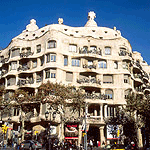
Architect: Antoni Gaudi, 1905-1910. Located in Barcelona, Spain. Which has Mediterranean climate. This building type is multifamily housing in art nouveau style.

I like this art nouveau building, it’s like ghost house, with wavy façade, large pores, curvy shape, makes good impression of ghost house :D


Architectural picture:


Interior pictures:


ART NOUVEAU

Art nouveau style is derived from plant-forms. Sometime uses parabolas or hyperbolas feature. In architecture and interior design this art nouveau style eschewed the eclectic revival styles of Victorian Era. This style is used stylized organic forms as a source and sometime elements like flame or shell from rococo style. Also Japanese print inspired the art nouveau style.


Art nouveau is involved in every aspect of design, architecture, interior design, furniture design, decorative arts including jewelery, textile, lighting, household utensils, sculpture and graphic art.

The colors used are elegant and subtle. Olive, gold, brown, sage, purple hues, lilac and violet, Peacock blue and salmon.

Read More......
Template by - Abdul Munir | Daya Earth Blogger Template